November 28, 2025 | Catherine Maggiori, PhD, Strategist at Supreme Group
The FDA Crackdown: What it Means for the Future of Pharma Marketing
The U.S. Food and Drug Administration (FDA) has recently adopted a more aggressive stance on prescription drug promotion. On September 9, 2025, the FDA, in conjunction with the U.S. Department of Health and Human Services (HHS), announced rulemaking to mandate clearer risk presentation in broadcast DTC ads. When viewed alongside a large upswing in enforcement letters, this signals a clear two-track strategy: immediate policing of current violations combined with a long-term reshaping of risk disclosure by pharma companies.
To decode the strategic implications of this shift, Supreme Pod host Eric Southwell sat down to discuss the topic with Shannon Carlson of Curator24 and Olly Johnston of Supreme Group.
Their consensus? This is not just about rewriting copy; it’s about rethinking how pharma marketing campaigns are planned, built, and delivered to audiences.
At its core, the conversation outlined an upgraded playbook for pharma marketers that relies on two main components. First, mastering the “Four Pillars” of patient-centric messaging, and second, modernizing the operational workflows required to sustain them.
To learn more, watch the full episode above or read our summary below.
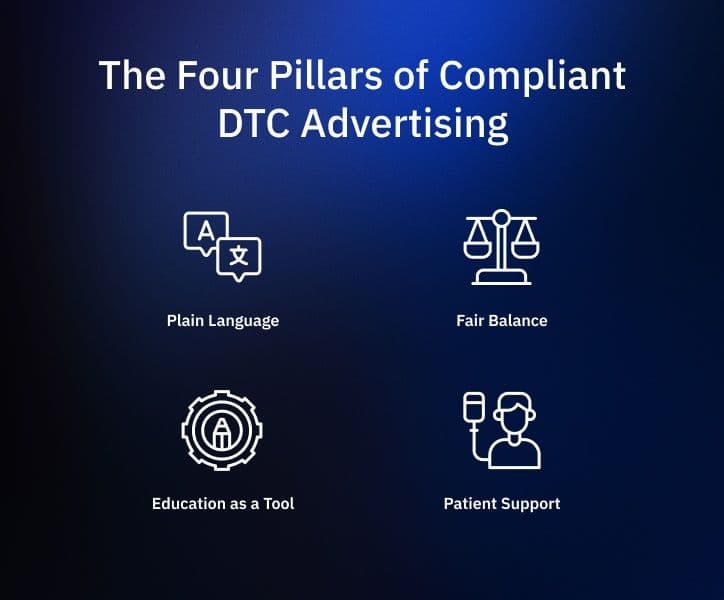
The Four Pillars of Compliant DTC Advertising
The main takeaway from the episode was Shannon’s four pillar framework for meeting the FDA’s new requirements head on. These pillars are outlined in more detail below.
Pillar 1: Plain Language as the Foundation
The real-world reality is that patients often encounter health messages when their attention is limited and their stress levels are high. To help them process information effectively and better meet the FDA’s updated requirements, marketers must use plain language to make key points easy to grasp on the first pass.
Plain language is often mistaken for “dumbing down”, but in the context of the FDA crackdown, it has specific, practical utility. Fundamentally, it requires pharma marketers to use short sentences, familiar words, and clear next steps that patients and caregivers can understand in real-time, without needing technical knowledge or a medical degree.
To achieve this, teams should audit their copy against three specific standards:
- Target the right reading grade level: Aim for a significantly lower reading level than standard brand copy. As Shannon put it during the episode, “You should be speaking to the general population at a third-grade level,” especially when people are processing complex or difficult information about their own health.
- Structure for action: Place clear summary information and action steps up front, then follow up with the supporting science (i.e., mechanism of action, indication, benefits, risks). Use direct, actionable wording and structure so people know exactly what to do and when to do it.
- Integrate risks clearly: Do not rely on fine print or external links to carry the weight of compliance. Present material risks alongside benefits with equal prominence and clarity across TV, web, and social.
The new reality is that using plain language to increase health literacy is now the standard. As the FDA moves to require clearer on-screen risk disclosures in broadcast DTC, they will actively target promotions that obscure safety information with complexity. Given this, marketing teams that write plainly will meet both the letter and the spirit of the new rules.
Pillar 2: Fair Balance as a Performance Feature
Fair balance has traditionally been viewed as a constraint: giving risks enough prominence and placement to match efficacy claims. However, in the current enforcement climate, applying fair balance correctly is not a tick-box exercise; it is a fundamental requirement that will attract regulatory scrutiny if not appropriately addressed.
To achieve this, marketers must match each benefit with the relevant constraint in real-time. For example, if you highlight a specific improvement over a defined time period, place the key limitations and common adverse events immediately beside it in language people can easily process. As Shannon emphasized, “We just can’t talk about the upside. We have to be able to present both the benefits and the risks so patients understand the full scope.”
Channel execution also matters. As Olly observed, “a lot of the ads that were flagged were big TV ads. They were the biggest channel … impacted, as well as social and influencer [content].” The practical consequences? For DTC TV spots, the major statement must be delivered in a clear, conspicuous, and neutral manner, which means avoiding distracting visuals and presenting readily understandable visual and audio information.
Ultimately, when risk language isn’t incorporated properly alongside benefits, ads tend to “sell hope” over reality, especially for products that help manage a condition rather than curing it. The FDA’s September 9 announcement has raised the bar: teams must honor the parity between benefit and risk to protect patients from overpromising and avoid unwanted regulatory scrutiny.

Pillar 3: Providing Education Beyond the Initial Ad
A 30-second TV spot is rarely enough time to explain a disease state or a complex mechanism of action, especially when fair balance requirements eat up half the clock. Education is how you extend patient understanding beyond that single, fleeting exposure.
As Shannon Carlson suggests, the goal is to “put yourself as a pharma company in the role of the educator,” shifting the focus from brand impressions to “giving patients the tools to have better, more informed conversations with their doctors.” This requires turning education into a system. Rather than relying solely on the primary advertisement, marketers should build a wider range of campaign companion assets. These might include:
- Glossaries and FAQs: Simple definitions of complex medical terms to lower the cognitive load.
- Step-by-step explainers: Visual guides on how a mechanism of action works or how to administer a treatment.
- Visit prep guides: Tools that help patients organize and clarify their thoughts, worries, and questions before they walk into a clinician’s office.
As Shannon said during the episode, “if we can really think about shifting our messaging into an educational voice,” it will help people “understand their disease state [and] understand the drug that they may be prescribed.”
Done well, these tools allow brands to meet patients where they are in their journey, helping them process information in difficult moments and decide on appropriate next steps with their clinicians.
Pillar 4: Providing Patient Support Beyond the Ad
In most cases. value is only delivered when a patient can actually access a treatment, yet many campaigns stop at awareness. Shannon noted that the industry must provide “support beyond the ad,” moving the goalpost from simply delivering a message to actively connecting people with the affordability programs and real-world resources they need to learn about, access, and start therapy.
To make this connection effective, companies must eliminate friction in the user experience. Support programs often fail because of complexity; therefore, teams should prioritize simplifying onboarding by shortening enrollment forms to their absolute essentials and setting clear eligibility expectations up front. Real-time help, such as live chat or secure messaging, also ensures patients aren’t left guessing in critical moments.
Crucially, because this depth of support often involves collecting Personal Health Information (PHI), strict adherence to HIPAA guidelines is non-negotiable. Protecting this data is not just a regulatory requirement; it is the foundation of the trust you are working to build.
As Shannon summarized during the conversation, “We’re not only helping the patient population, but we’re helping the industry get to a better place.” When support is visible and usable, it ensures that your marketing investment is better positioned to actually lead to patient treatment.
How Marketing Operations Must Evolve to Meet the New FDA Requirements
While these four pillars are necessary to meet the new levels of communication rigor required by regulators, executing them creates a massive volume of work. In most cases, marketing teams will need to thoroughly audit and update all existing content, while also developing new processes for producing future content. That’s a big lift.
To keep up with these new demands without breaking the bank or the timeline, marketing teams will need to fundamentally change not just the nature of the campaigns they create, but how they build them.
The Need for Modular Content
Traditional, bespoke asset creation is too brittle for the current regulatory environment. In a standard workflow, where every ad is built as a unique, static file, a single regulatory objection regarding a specific phrase can necessitate a manual rebuild of the entire portfolio.
This fragility is a major risk. As Shannon highlighted, “They’re going to continue to [further] tighten the rules and regulations.” If your content is static, every tightening of the rules creates a crisis.
When an enforcement letter lands, the operational reality is immediate and severe. During their discussion, Eric, Shannon, and Olly noted that teams often face a “full sweep of every single piece” of content in the market, forcing them to pause active media campaigns to align with new standards. Recent trade media coverage echoes the scale of these crackdowns, underscoring that re-auditing claims one by one is no longer a viable option.
To survive such regulatory crackdowns, Olly recommended moving toward “building more modular content so that we can get to derivative versions quicker.” This approach fundamentally changes the audit and content creation process.
By assembling a central claims library, reusable design components, and standard risk-benefit pairings, teams can decouple the “message” from the “format.” When a regulatory change occurs, the team updates the single source block, and that compliance edit can cascade across TV, web, social, and print assets with greater speed and efficiency. This allows marketers to react to FDA guidance in hours rather than weeks, protecting both the brand and the timeline.

Using AI To Accelerate Governance via Pre-Review
Once the content is modular, AI becomes the engine that accelerates it, but only if it lives inside strong governance. During the episode, Shannon emphasized that hearing “AI” alongside security and privacy “has to terrify some people,” and rightfully so. In a regulated industry, generative models that are prone to hallucination and errors pose a significant risk.
To mitigate this, teams should strictly operate within protected environments with clear data use rules that remain compliant with HIPAA laws. For guardrails, leaders should lean on established, federally recognized tools, such as the NIST’s AI Risk Management Framework, rather than creating internal policies from scratch.
With those protections in place, AI functions best as a pre-review assistant rather than the final approver. During the discussion, Olly described the most effective workflow as “training an AI on the regulations and using it as a filter for any new content before it gets to the Promotional Review Committee (PRC).”
By acting as a first line of defense, the AI can flag non-compliant language or mismatched risk information instantly. While the final approval “is always going to end up with a human,” using AI to scrub claims before they reach the formal review stage can significantly reduce friction and shave days off the approval cycle.
Scaling Personalization
During the episode, Shannon raised another important issue likely to impact pharma marketers in the future: as content becomes more tailored, the operational workload shifts from managing a few broad segments to managing many micro-audiences. As she puts it, “maybe you only had 3 segments before, now you might have 46.” This takes all of the issues we’ve discussed so far and scales them exponentially across multiple audience segments.
Human teams cannot manually version-control compliant content for large numbers of different audience segments without introducing error or delay. Fortunately, modern AI tools can also make it easier to deliver this level of personalization at scale by taking a pre-approved modular claim and transposing it across dozens of variations. This ensures that different segments of both patients and healthcare professionals (HCPs) receive messaging that feels relevant to their specific needs, without losing the strict accuracy, fair balance, and clarity required by regulatory bodies.
Conclusion: Regulatory Compliance as a Path to Patient Trust and Commercial Advantage
While the FDA crackdown presents a significant operational challenge, it also offers a rare opportunity to reset the foundation of pharma marketing. Shannon’s “Four Pillars” (plain language, fair balance, a commitment to deeper education, and expansive patient support) offer a framework for meeting this issue head on.
By embracing these changes now and auditing claims, simplifying copy, and adopting AI-driven workflows, teams can turn regulatory friction into a competitive advantage, building a marketing engine that is safer, faster, and ready to meet further regulatory changes as and when they arrive.
Ready to go deeper? Listen to the full episode with Eric Southwell, Shannon Carlson, and Olly Johnston on Spotify, Apple Podcasts, YouTube, or wherever you get your podcasts.

