May 19, 2026 | Paul Avery, VP Marketing, Supreme Group
The First Breath of a Pharma Brand
A pharma brand starts taking shape long before anyone sees the logo on a package, the booth at a congress, or the first launch campaign in market. Early work is often quieter and more strategic. It begins when a company moves from internal confidence in the molecule to external clarity about who the product is for, what those people need to believe, and which conditions must exist before the brand can succeed.
The team at Broth call that moment the first breath of a brand.
In Episode 9 of The Supreme Pod, I sat down with Elizabeth Yi, Doug Tischler, and Meredith Pugh from Broth (part of Supreme Group) to explore what that process requires. Our conversation moved from science and market preparation to message discipline, research judgment, patient experience, and the practical realities that shape adoption.
For anyone involved in pharma marketing, especially in an early-stage biotech or first-time launch environment, the discussion offers a useful reminder: a brand is born through more than a creative exercise. It emerges from a sequence of choices that help the market understand why the product matters and why now is the moment to pay attention.
You can watch the episode in full above, or read the blog post below for a summary of our conversation.
A Brand Begins When the Molecule Starts to Mean Something
The first breath of a new pharma brand begins with a shift in perspective. Inside a biotech or pharma company, the molecule has often been the center of gravity for years. Teams have focused on pre-clinical testing, clinical trial protocols, enrollment, data collection, regulatory milestones, and all the other internal work required to prove the product can move forward.
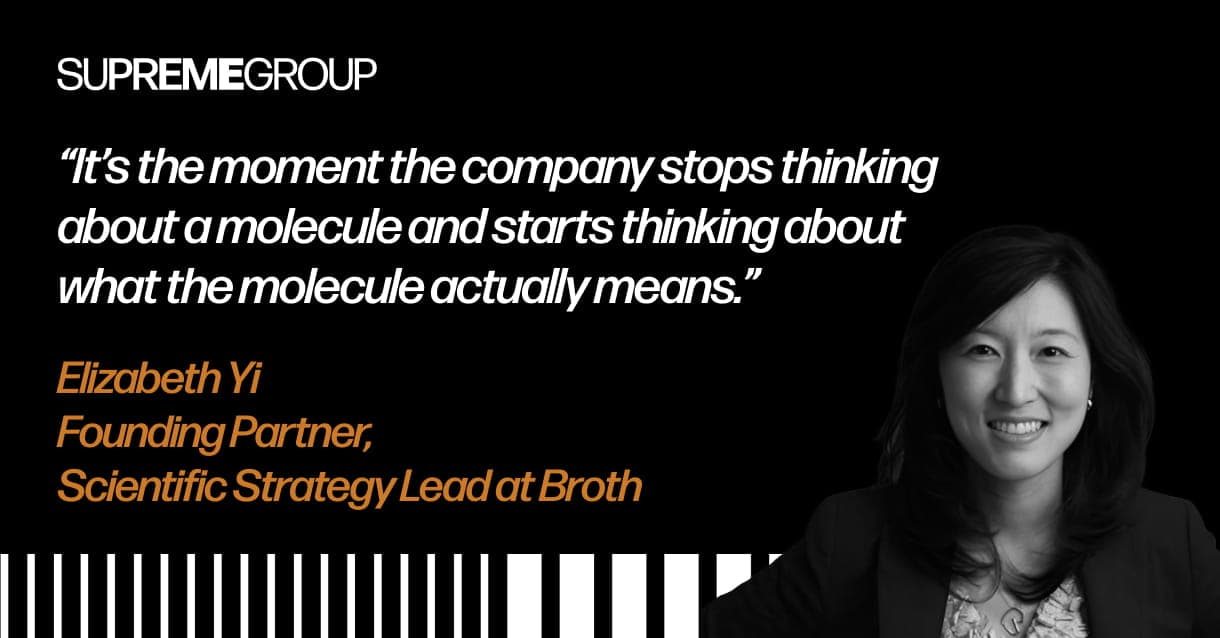
Eventually, that internal focus has to open outward. Liz described the turn as “the moment that the company stops thinking about a molecule and starts thinking about what it is that the molecule actually means” for physicians, patients, and the communities the product is meant to serve.
From that point on, the brand work expands beyond proving whether the molecule works. It asks how the market should understand the product, who needs to be prepared for it, and what beliefs need to change before adoption becomes possible.
Liz put the practical questions simply: “Who’s it for? What do they need to believe?” Those two questions sound basic, yet they force a company to move beyond internal product development and into the harder work of external meaning. A physician does not encounter a new therapy as a molecule in isolation. A patient does not experience it as a data package. The wider community does not judge it by its mechanism of action.
Instead, every audience receives the product through the context of its existing needs, habits, hopes, skepticism, and constraints. The first job of brand development is to understand those contexts deeply enough to make the science and product matter outside the company that created it.
Start By Diving Into the Known Data
After recognizing that the brand is ready to move from molecule to meaning, the next question is where to begin. Doug described the first practical step as immersion: getting into the data, understanding what the molecule does, studying the market, and learning the customers who will eventually be asked to use or support the product.
The company usually knows the compound far better than any outside partner does, so the pharma marketing agency has to close that gap quickly. As Doug explained, for the team at Broth, their first responsibility is to become “just as smart as the people at the company who’ve been working on [the project] for years.”
Liz named a key constraint that often impacts Broth’s ability to gather all the information they need to start building the brand. As she said, “oftentimes we don’t know the clinical effects yet because the trials are still ongoing.” The uncertainty changes the nature of the work. Rather than building the story around claims that may shift, the team has to find what is ownable in the science and stable enough to carry forward. A brand cannot be built on wishful thinking about future data. It needs an anchor that can survive new information, scenario planning, and the inevitable changes that come as the product moves toward launch.
Meredith described that early period as almost gestational. Projections, scenario planning, rigor, and imagination all sit together because the team is making decisions before the final shape of the product is fully visible. The goal is to identify what will remain true while leaving room for everything that still needs to emerge.
Together, those constraints make early pharma marketing different from later-stage campaign execution. The team is finding the stable truth that can hold the story together while the product, market, and evidence base continue to mature.
Prepare the Market Before the Brand Arrives
Understanding the current state of the data around a new product gives the emerging brand a foundation. However, market readiness has to be built separately. A company can understand its molecule and disease targets perfectly and still launch into an audience unprepared to receive it.
Market preparation is the earlier work of helping the right audiences see the disease state, unmet need, behavior gap, or coming scientific change in a new way. Some of that work may happen before branded communication is possible. Its job is not to sell the product directly, but to create the conditions in which the future brand can make sense.
Timing matters because a launch can be asked to do too much. If launch is the first moment people are asked to recognize a problem, reconsider a habit, and evaluate a product, the brand has to create awareness and change behavior at the same time. Liz said the process is “always longer than people think.” In ideal conditions, that work can take years because, as she put it, “Humans don’t realize they have a pain point. They don’t realize they’re missing something. They don’t realize that it could be better.”
Early market preparation is connected to formal brand development, but it is not quite the same work. Doug pointed to Phase 3 as a common moment when the brand can begin to take more concrete shape. By then, a company often has Phase 2 data, a Phase 3 study design, a target product profile, and enough knowledge of the disease state to start building the roadmap. Market preparation helps the audience become ready for the change. Brand development defines how the product will own and communicate that change when it arrives.
Even though it’s tempting to provide concrete guidance on timing, the reality is that every launch has its own timeline, and Liz also made clear that Broth has launched products on short notice. But what we can say is that the ideal runway gives the market time to understand why the coming product deserves attention before the brand has to earn adoption.
The specific details of preparation often vary heavily by category. In a no-treatment disease state, education may focus on disease burden, unmet need, or a new mechanism of action before branded communication is possible. In an existing/competitive category, communication often focuses on one or two key elements. To bring this idea to life, Meredith gave the example of a hypothetical product that works faster than existing options. In that case, prelaunch education has to make the cost of slower resolution visible, because broad education that is not tied to the future product’s differentiator can end up benefiting competitors.
Market preparation, then, requires more precision than generic awareness building. It is the careful work of preparing the right audience to recognize the specific change the product can make.
Translate Deep Science Into Human Meaning
Preparation creates the opening, but the science still has to be translated in a way each audience can understand. While internal technical teams often live inside technical detail, clinicians, patients, caregivers, payers, and institutional stakeholders meet that detail from different positions, with different responsibilities, questions, and thresholds for action. Meredith framed the challenge clearly: “On the other side of deep technical information are still human beings in a healthcare ecosystem.” Each audience needs a different level of detail and a different route into the story.
Bridging technical depth and sticky communication starts with understanding how those people experience the category. Meredith connected that work to insight, audience sentiment, and the reality of the audience’s world. As well as a critical understanding of all these audiences, the brand team has to comprehend the science deeply enough to make the right information usable.
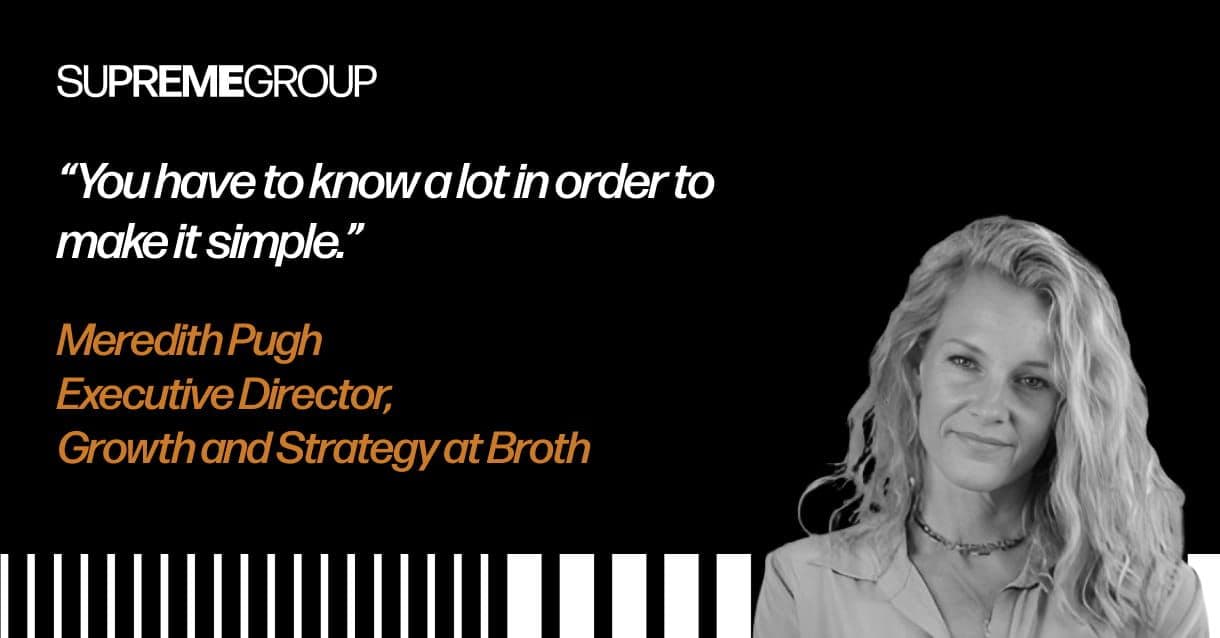
Meredith summed up the discipline neatly: “You have to know a lot in order to make it simple.”
Simplicity in this context is the result of fluency. A team that barely understands the science can only strip it down. A team that understands the science, the audience, and the market can decide what each audience needs to know, what can be left aside, and how to make the central idea memorable without losing scientific integrity.
Liz added an important caution to this framework from the team’s experience working across rare diseases. In many rare disease settings, patients and families may know more about their condition than a typical physician, so their expertise can often disrupt hasty or generic assumptions about patient knowledge. The “simple” version cannot be simplistic. It has to respect the knowledge, emotion, and lived experience of the people receiving it.
Find the One Idea the Brand Can Stand For
After the team understands both the science and the audience, the next challenge is focus. Translation creates many possible messages. Brand strategy requires choosing the one that matters most. The team has to ask what the brand should stand for in a crowded, noisy world. The core communication may never appear word for word in external materials, but it gives every future message a center of gravity.
From there, the story expands outward. Physician messages usually come first because physicians are often the first clinical audience the launch needs to reach. Then the team adapts the message map for other audiences: allied health professionals, patients, caregivers, advocacy groups, payers, and others who each have different priorities and roles in the product’s success.
Good message architecture gives the brand both consistency and flexibility because it separates the central truth from the way that truth needs to be expressed. The core idea stays stable, while physicians, patients, caregivers, advocacy groups, payers, and internal teams each receive a version that fits their role in the product’s success. Without that discipline, the brand can fragment. Every team, stakeholder, and research comment can pull the message in a different direction.
Liz turned that risk into the simplest possible rule: “You can’t say everything because then nothing comes through.”
Her line sits at the heart of effective pharma marketing. A launch wins attention by making the most important truth clear enough to remember, then supporting that truth with the right evidence, messages, and experiences over time, often subtly customized to meet the needs of each audience.
Use Research to Make a Braver Choice
Once the brand has a point of view, research should sharpen judgment rather than flatten the work into the safest possible answer. In this light, market research plays an important role in brand and message development because it shows how audiences receive the work, where the story is clear, where it creates friction, and which claims or ideas need more support.
However, Doug warned against treating it as a simple contest for the message most physicians like. The most comfortable answer in research may leave behavior unchanged.
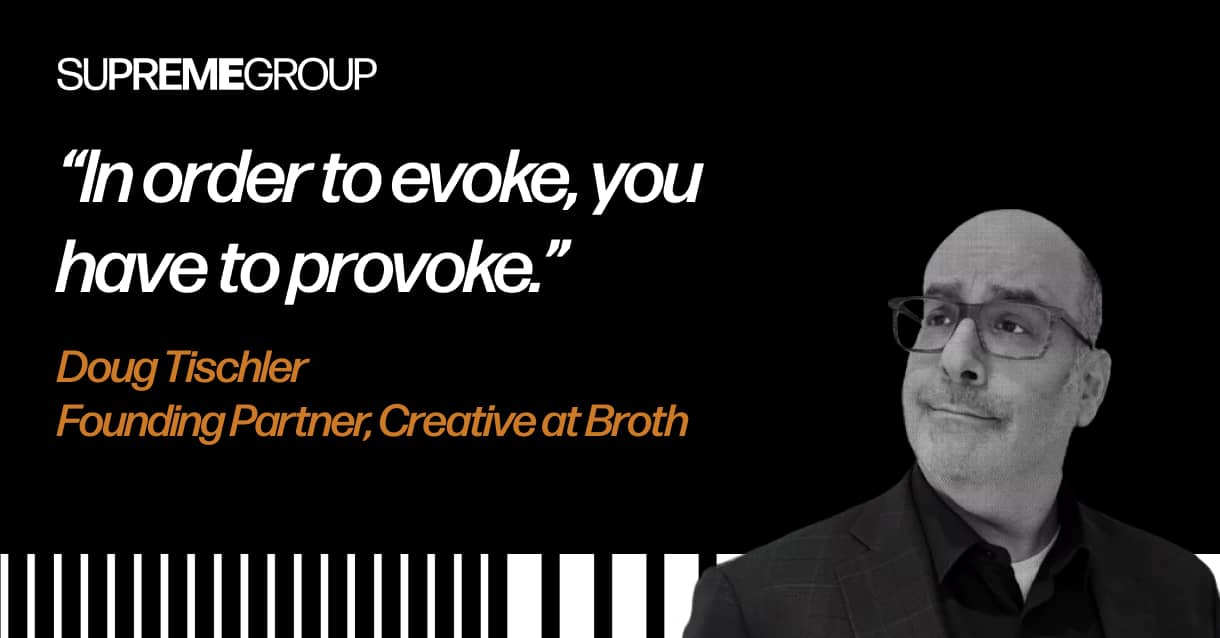
As Doug put it, “in order to evoke, you have to provoke.” Comfortable messages may validate what physicians already believe. Provocative messages, when grounded in evidence and strategy, can make an audience reconsider a habit or see a familiar category differently.
Doug’s point goes beyond provocation for its own sake. A braver message only works when it grows out of the earlier discipline: immersion in the science, clarity about the market, deep audience understanding, and a focused message strategy. Without those foundations, bold work can become inaccurate, tone-deaf, or disconnected from the behavior the brand needs to change. But with them, a stronger idea can be defended because the team understands why it matters and what it is meant to do.
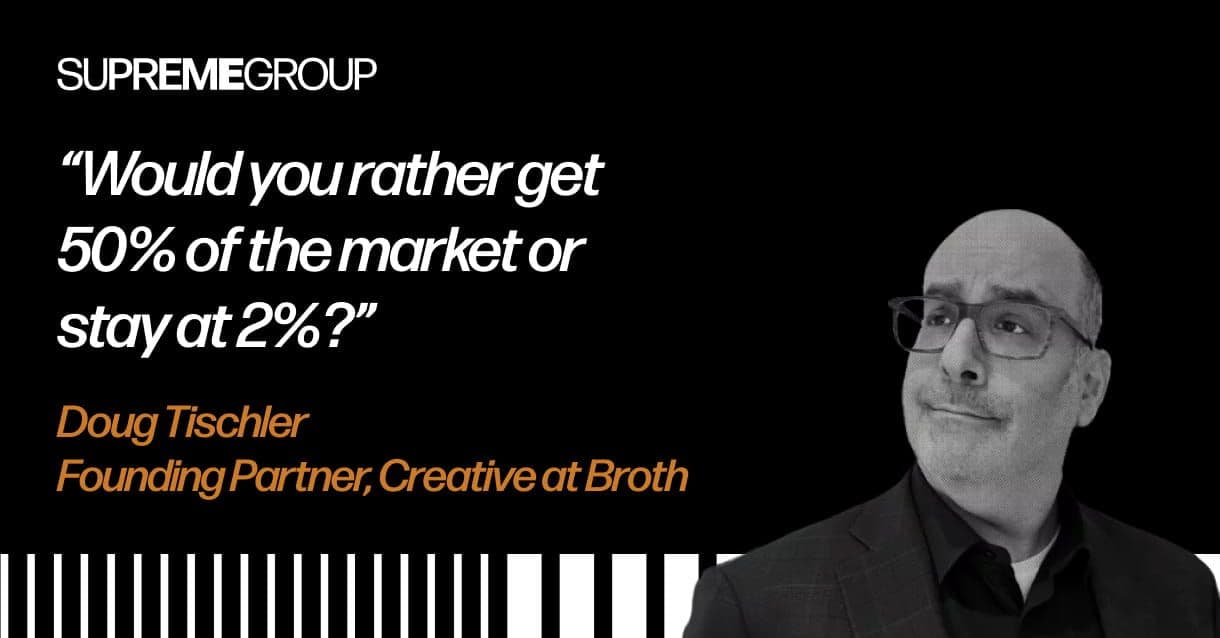
Doug brought the point to life through a diabetes example. The drug had 2% of the market, and the team developed work that some physicians found polarizing. The client’s first reaction was understandable: polarizing sounded risky.
Doug asked a sharper question: “would you rather get 50% of the market or stay at 2% of the market?”
While those numbers belong to that specific anecdote, not to a universal rule about provocative creative, the broader lesson is about interpreting research in context. A split reaction can be a warning sign, or it can reveal that a message is finally strong enough to challenge the status quo. The difference depends on the strategy, the audience, and the change the brand needs to create.
Liz added that clients can only make those non-obvious choices when they trust the agency’s judgment. Such trust starts earlier than the research debrief. It starts from day one, when the agency demonstrates that it understands the client’s goals, the molecule, the disease state, the patients, and the wider market. A pharma marketing agency earns the right to recommend a braver path by showing that the recommendation is grounded in the realities of the product and the people it is meant to serve.
Build the Experience the Brand Needs to Land
Meredith pushed the conversation beyond messaging into the conditions that make adoption possible. For complex therapies, especially genetic-level therapies, one-time-use therapies, or complicated treatment journeys, she put the distinction simply: “Brand does not always equate to experience.”
Adoption may depend on more than whether the brand is memorable or the message is clear. Institutional readiness, commercial purchasing reality, HCP workflow, patient resistance, and the practical or emotional burden of the treatment experience can all affect whether the product moves from interest to use.
In some cases, the smartest brand work starts by asking whether the functional conditions around the product are ready. Are institutions prepared to receive it? Do physicians understand when and how to use it? Does the customer experience move people from one step to the next, or does it fracture across disconnected systems?
Liz named a related launch condition directly when discussing successful launches. At least in the US, she said, teams cannot forget how important it is that physicians and patients can actually get access to the drug. Access and logistics sit alongside KPIs, audience targeting, and omnichannel strategy because the brand has to operate in the real world alongside the messaging framework.
Meredith illustrated the point with a rare disease example. The product had stronger efficacy, and the team had a clear message around that advantage. But there was another challenge sitting inside the treatment journey: patients would need to use an at-home self-administering kit.
The kit could not be treated as a minor detail. For patients, it was one of the most tangible parts of the product experience. If it felt intimidating, clinical, or burdensome, the strength of the efficacy story might not be enough to overcome hesitation.
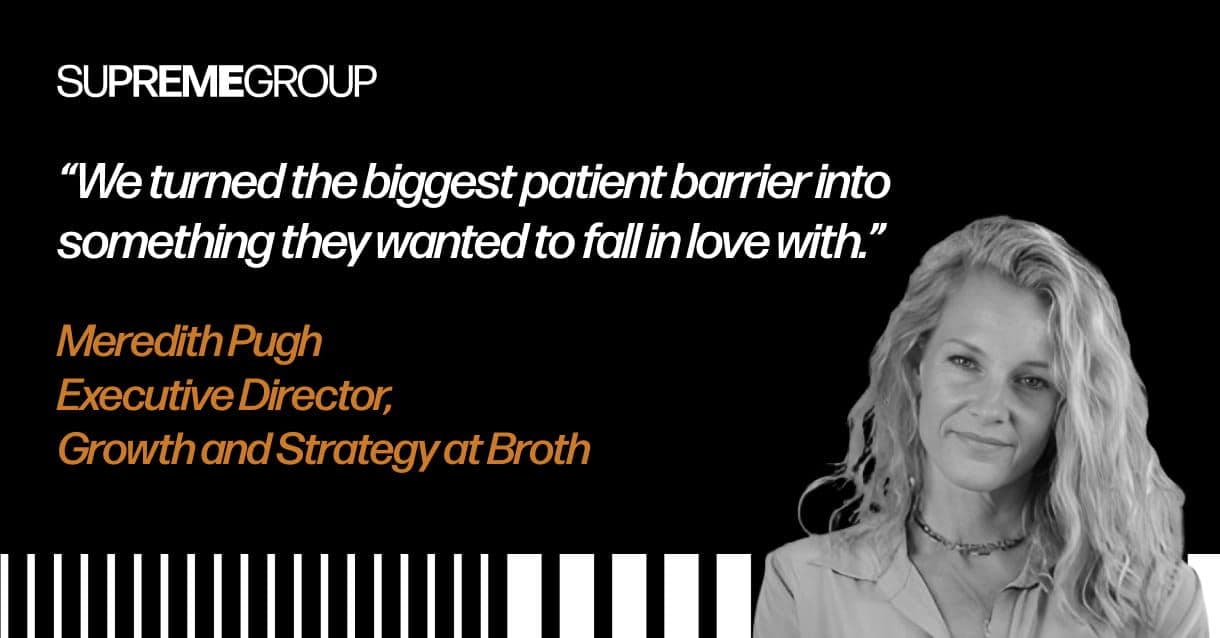
So the brand question became an experience question. How could the team help patients feel differently about the kit itself?
“We turned the biggest patient barrier into something they wanted to fall in love with,” Meredith said.
In this case, by bringing in a well-known designer admired by the patient community, the team changed the emotional relationship people could have with the kit. The brand came to life through more than a claim about efficacy. It came to life through an experience that helped patients feel differently about the practical reality of using the product.
For the Broth team, the lesson was practical: experience work often begins where a barrier could stop adoption. The team was not trying to decorate a difficult treatment step after the strategy had been written. They were asking what would make the product feel more acceptable, more personal, and easier to imagine using.
The Brand Becomes Real in the World
By the end of the conversation, Doug brought the arc back to the visible moments when the brand finally becomes real. He described four milestones: the first branding process defining the logo, colors and key messages; the creative concepts that give the campaign a face; the moment the product is approved and used by physicians or patients; and the first time someone sees their creative work in the world at a congress, booth, or doctor’s office.
For pharma and biotech teams, the lesson is that a launch brand comes alive through a connected sequence. The molecule becomes meaningful. The science becomes stable enough to carry a story. The market gets prepared. The complexity becomes human. The message gets chosen. The research is interpreted with judgment. The experience supports adoption.
When those pieces work together, the brand can finally feel alive.
At that point, the first breath becomes something more than a metaphor. It becomes the moment a product starts to meet the world it was built to serve.
Ready to go deeper? Listen to the full episode with Paul Avery and Elizabeth Yi, Doug Tischler, and Meredith Pugh on Spotify, Apple Podcasts, YouTube, or wherever you get your podcasts.

