
February 2, 2026 | Eric Southwell, CMO at Supreme Group
The Secrets Behind Effective Thought Leadership in Health Tech with Jodi Amendola
For senior healthcare marketers, the pressure tends to feel the same, even when the market shifts. You always need more awareness, more credibility, and a growing pipeline, all while competing in categories where there are hundreds of vendors saying similar things. So where do you put your energy when attention is scarce and budgets do not stretch as far as they used to?
This was the topic of the latest episode of The Supreme Pod, where I sat down with Jodi Amendola, founder of Amendola Communications (now part of Supreme Communications), to discuss what credible thought leadership looks like in the health tech industry.
With over 30 years of experience in health tech PR and communications, plus recognition as a Forbes Council contributor and Becker's Top 100 Women in HIT, Jodi and her team have helped hundreds of companies cut through the noise in one of healthcare's most crowded spaces.
During the episode, Jodi and I unpack the thought leadership strategies that work best in health tech. You can watch the episode in full above, or read the blog post below for a summary of our conversation.
Why Thought Leadership Still Wins in Health Tech
Thought leadership as a commercial driver is not new. However, according to Jodi, it remains one of the few marketing disciplines that has "really endured the test of time" across her three decades in the industry. The reason is straightforward: in a market where expertise, evidence, and credibility matter most, thought leadership remains one of the most effective ways to demonstrate to your target audience that you are worth trusting and ultimately worth purchasing from.
For example, consider the position of a smaller health tech company trying to compete against better-funded rivals. Traditional marketing often comes down to budget, and whoever can spend the most on ads, events, and sponsorships tends to dominate the conversation. However, thought leadership offers a different path. As Jodi explained:
"Even companies that are really small that want to look big, or a big company that's big, but wants to look like the biggest or the leader in the space can do so with an effective thought leadership program."
The implication here is significant. According to Jodi, with a well-executed strategy, companies of any size can "control the narrative, control the perception, and gain a competitive advantage" without needing to match their competitors dollar for dollar. You can shape how the market perceives you, regardless of your headcount or your marketing budget.
The Fundamentals: Engaging Messaging Without the Infomercial
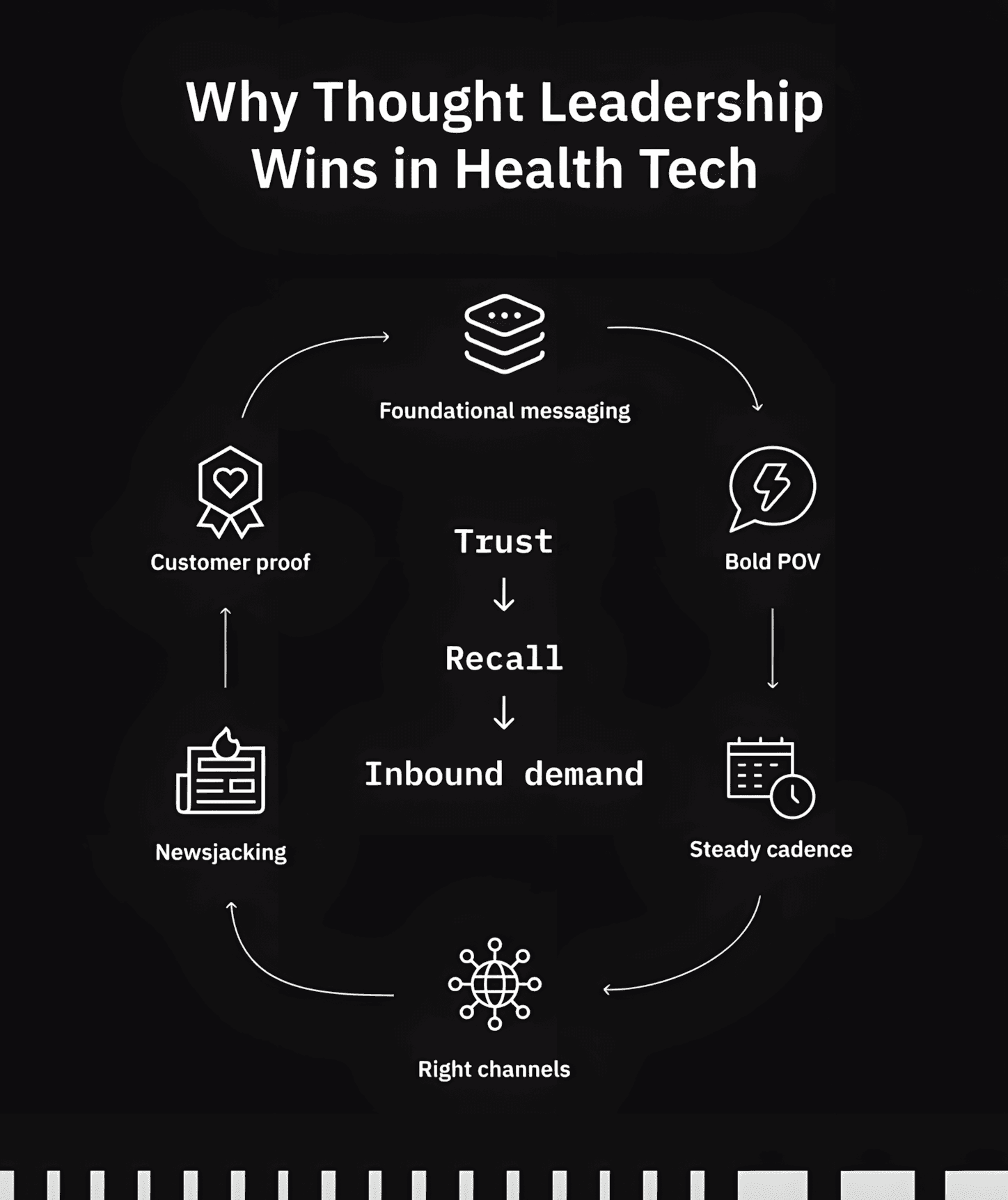
So how do you build a thought leadership program that delivers these results? According to Jodi, it starts with the fundamentals. As she told me, "You have to start with the basics. You have to have that foundational messaging that makes your company unique and that you build that strategy around your thought leadership. So you want to focus on the organizational, the vision for your industry and the challenges and the pain points that your company solves."
Once that foundation is in place, the next step is connecting your point of view to what is happening in the broader market. Thought leadership gains traction when it speaks to timely issues, current debates, and the challenges your audience is actively thinking about.
However, there is a critical boundary to respect. As Jodi put it, "The key with thought leadership is that you can't be promotional. You want to weave your messaging into those topics and the thought leadership, but you want to be educational and informative rather than an ad for your company, because nobody's really interested in that."
Getting this balance right requires discipline. You’re still communicating what makes your company valuable, but you are doing so by demonstrating your expertise and offering genuine insight rather than pitching your product directly.
Stand Out Faster with a Bold POV and a Steady Cadence
With the fundamentals in place, the next question becomes how to cut through in a crowded market. Many health tech marketers get stuck at this stage. They understand the value of thought leadership, they commit to staying educational, and then they produce content that sounds exactly like everyone else in their space. Safe. Measured. Forgettable.
Jodi's advice? Push harder.
"Some of the key things with thought leadership is really being provocative, being edgy, not just saying the same old thing. So you want to draw attention, right?"
Now, Jodi carefully clarified that playing it safe is not inherently incorrect. As she said, "I'm not saying that playing it safe is bad or wrong and that you can't build thought leadership. But if you want to get there a little quicker and really stand out, then being a little edgy or provocative can go a long way," she said.
However, boldness alone is not enough: "You can't just expect to do one interview, one podcast, you know, send out LinkedIn posts haphazardly and become a thought leader. There has to be a thoughtful strategy behind it and you can't be self-promotional and you have to have that steady cadence."
When your audience sees the same informed perspective showing up consistently across multiple channels, they start to associate your brand with that POV. Over time, repetition builds recognition, and recognition builds trust.

People Follow People: Executive Thought Leadership on LinkedIn
Another key aspect of thought leadership is channel selection. You need to ensure your perspective reaches your target audience. In this regard, LinkedIn has become a key channel within health tech PR and communications.
Choosing LinkedIn as a platform is a smart move, as the buyers and the influencers who shape buying decisions are active there; Chief Medical Officers, Chief Information Officers, and a wide range of relevant health tech professionals are all consuming content on LinkedIn. Meeting them where they already are is essential.
What should you post about? Well, according to Jodi: "Eighty percent of the content that we post on social is informative, is educational. Twenty percent can be about your company. “Yes, I'm gonna be at this trade show or I'm going to be doing this webinar,” that kind of thing."
In practice, the 80% should include commentary on industry research, perspectives on emerging trends, and informed takes on the challenges your audience faces. The 20% covers company-specific content such as conference appearances, webinars, and promotions of earned media coverage.
What makes LinkedIn particularly powerful for thought leadership is the human element. Company pages have their place, but as Jodi observed, "at the end of the day, people follow people. And so you want to have those executive thought leaders posting on a steady cadence. And I've seen the tremendous impact it makes."
Importantly, Jodi shared an observation during our conversation that challenges conventional wisdom around social engagement metrics:
"Even if people aren't engaging with your post - they may not be liking it, they may not be commenting - they're seeing it, they're remembering it and they will reach out to you when the timing is right. It happens to me all the time."
Your executives may post consistently without seeing a flood of likes or comments. That doesn’t mean the content is failing. People are watching, even when they are not publicly engaging, and they remember who showed up with valuable perspectives when they are ready to make a purchase decision.
Who Should Be a Thought Leader in Health Tech?
During our discussion, I asked Jodi a question that comes up frequently in health tech marketing conversations: how do you decide which voices should represent your organization’s thought leadership efforts?
While the CEO typically needs to be front and center in any thought leadership program, Jodi recommends that organizations should rarely rely on a single “perfect” spokesperson to carry the entire narrative. As she explained, "When you're reaching a specific audience, you want to communicate appropriately to that audience. So for example, if there's a podcast and they have a CMIO host, we want the guest from the client to be a CMIO for the client company, right? To engage in that peer-to-peer conversation."
In practice, spokesperson selection should be guided by the topic and the target audience. A CIO speaks to technology buyers. A CFO addresses financial decision-makers. A chief nursing officer, clinical study director, or chief medical officer carries weight in clinical conversations. Keeping this in mind and matching the messenger to the audience where possible helps to strengthen the credibility of the message.
As Jodi said: "What we do is we come up with the different topics that each C-level suite executive can speak to and promote their thought leadership to appropriate audiences."
Jodi also acknowledges that not every executive is naturally comfortable in the spotlight. Some may be hesitant about media interviews or public speaking. In those cases, media training becomes essential, as pushing an uncomfortable spokesperson into high-visibility situations without preparation benefits no one.
"If a CEO or another thought leader doesn't feel comfortable, then you don't want to throw them out there because that's not going to be a good experience for anybody," she said.
Building a bench of credible, well-prepared thought leaders gives you flexibility. You can match the right voice to the right opportunity, and you reduce the risk of burning out a single executive with every request.
Newsjacking: Use Speed, Insight, and Timing to Earn Attention
Thought leadership does not happen in a vacuum. The most effective programs leverage and speak to the issues and events that are already commanding attention in the market, especially those that are currently dominating the news cycle. Jodi told me that the communications industry calls this practice newsjacking, and she considers it critical to effective thought leadership.
How does the process work? When something significant happens in health tech, whether a regulatory change, a major industry challenge, or an unexpected disruption, you must move quickly to offer your perspective (often within hours or days). In terms of execution, your thought leaders could provide commentary, share guidance, or help audiences make sense of what is unfolding and where the future may be headed.
Jodi offered a concrete example to illustrate the approach:
"For example, if there's a hurricane and all of a sudden the systems go down in a hospital, it may be a thought leader talking about how do you get your backup data up real quickly or, you know, just kind of giving advice on what's going on."
The value here is twofold. First, you are providing genuinely useful information at a moment when your audience is actively seeking it. Second, you are associating your brand with timely, relevant expertise rather than evergreen content that could have been published at any time.
Speed matters in newsjacking. The window for relevance is often short, so having a process in place to identify opportunities and mobilize your thought leaders quickly gives you an edge over competitors who may move more slowly.
Customers Bring Credibility
One of the strongest points Jodi made during our conversation was about the power of customer proof.
Healthcare is a particularly peer-driven industry. Buyers want to know what their counterparts at other organizations have experienced, and they want to see real-world evidence that your solution delivers on its promises. Jodi is emphatic on this point: "The best way to build thought leadership by far … is to have your clients give their real world examples. Use case studies, use testimonials, videotape them, have them write articles, whatever, put them in front of the media. That will help go so much further."
Jodi also pointed out a common mistake she sees among health tech companies: an excessive focus on competitors. Some organizations become fixated on a single rival and orient their messaging around knocking that competitor down. In her experience, this approach backfires. As she said, "I think people get really hell bent on one competitor. And so sometimes it's about really knocking that one competitor versus showcasing how you're different, how you're changing the market."
Proof beats posturing. Instead of investing energy in competitor-focused messaging, channel your effort into capturing and amplifying the voices of customers who have benefited from your work. Their stories build the credibility that ultimately drives buying decisions.
Becoming a Health Tech Thought Leader
The health tech market is crowded and competitive. Budgets are tight. Sales cycles are long. Buyers are sophisticated enough to tune out anything that feels like an advertisement.
In this environment, thought leadership offers a path to visibility, authenticity, and credibility that does not depend on outspending your competitors. By building a strong messaging foundation, maintaining a steady cadence of valuable content, empowering multiple executives to speak to the right audiences, and letting customer proof do the heavy lifting, you can establish the kind of authority that keeps you top of mind when decisions are finally made.
As Jodi reminded us, the people who see your content may not always engage publicly. But they are watching, and when the timing is right, they will reach out.
Ready to go deeper? Listen to the full episode with Eric Southwell and Jodi Amendola on Spotify, Apple Podcasts, and YouTube, or wherever you get your podcasts.

